
Author’s Notes:
An Aide-de-Camp is a military officer acting as a confidential assistant to a senior officer.
A Khan, Spelled K, H, A, N is a king in historic Mongolic and Turkic.
Temüjin is the birth name of Genghis Khan
Jamukha (Ka Moo Ha) Khan (Mongolian: Жамуха) was a Mongol military and political leader and the chief rival to Temüjin in the unification of the Mongol tribes.
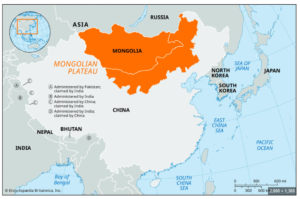
The Mongolian Plateau is an extensive northeastern highland region of the great plateau of Central Asia, covering an area of approximately 1,000,000 square miles.
It is bordered on the north by Russia and China on the south.
The Mongol Empire inadvertently spread the Bubonic Plague from Mongolia to greater Asia and Europe in the 1200s. Mongol soldiers and traders unknowingly carried rats and fleas infected with the disease across their empire and beyond. The fleas embedded themselves on the manes of horses, the hair of camels, or in saddlebags or cargo.
The Bubonic Plague killed up to 50% of the populations it infected in the centuries that followed.
The plague severely weakened the Mongols demographically.
The plague also killed many of the clergy, which led to religions playing a lesser role in societies and the emergence of new ideologies and technologies.
 It is in the midst of this terrible pestilence, we find ourselves in Mongolia where two main houses ruled, the house of Temüjin and his main rival Jamukha.
Each of them wanted to rule Mongolia at all costs.
They were always threatening the other with invasion.
But they both knew a divided Mongolia would never survive.
The Plague had taken many lives of both tribes and so the number of soldiers on both sides had dwindled, making full scale invasions impossible.
Jamukha sent a message to Temüjin.
He proposed that they meet alone on the field of battle, and settle their differences man to man. Their armies would only be spectators.
The victor would rule all of Mongolia.
Temüjin agreed as neither tribe could stand the loss of any more able-bodied men.
They agreed that only swords would be used.
Temüjin and Jamukha had once been allies, but were now bitter rivals.
But they still felt a kinship to each other.
Rulers, kings and khans, don’t have many contemporaries who can understand their world, their problems, their pressures. Only another ruler, king or khan could truly commiserate.
The respect they had for each other, although mortal enemies, was pure and immense.
On April 1st, 1206 AD, they faced each other on what today is called the Mongolian Plateau. This was the main land mass they were fighting over.
The armies approached each other near the village of Dundgovi, the agreed upon central location.
They stood 100 yards from each other. When healthy, both armies were 250,000 strong, now each side had under 100,000 troops, many of them sickly.
As was formerly agreed, a torch was lit on each side, signaling each side’s readiness.
An Aide-de-Camp from each side left their ranks, passed each other without a word, and met face to face with the enemy’s khan.
They unrolled a decree and read it aloud at the same time:
“(Temüjin or Jamukha), do you agree to a battle to the death, khan against khan, for complete rights and rule over Mongolia? Have your armies vowed to honor this agreement in the case you perish?”
Both answered in the affirmative.
The Aide-de-Camps returned to their khans and verified the enemy khan’s agreement.
The two men would battle alone, with the survivor left to rule and unify all tribes.
They told their soldiers, if they were to perish, no retribution was to be sought and they were to pledge allegiance to the enemy’s khan.
Temüjin and Jamukha left the safety of their ranks and approached each other.
They both knew that only a unified Mongolia could battle the great armies of Russia and China. If they stayed separate warring factions, that would see Mongolia fall.
They both were too headstrong and prideful to agree to joint rule.
Suddenly they were ten feet from each other, stone faced, trying desperately to not show the utter terror they were feeling.
They were in awe of each other, almost like they were meeting a mythological deity in the flesh.
They had never met a true equal before, except their fathers.
They approached each other, bowed, and raised their arms and pressed their forearms against each other’s.
The battalions began to move closer until they were only 100 feet away from their khans and the enemy.
Temüjin and Jamukha turned away from each other, walked ten paces and turned around.
There was complete silence.
They drew their swords.
The battle was fierce, with each drawing blood many times.
They impressed each other with their swordsmanship and stamina.
After one hour, Temüjin gained the upper hand.
Jamukha lay on his back panting and bleeding. He knew he had lost.
He turned his sword, handed the grip to Temüjin, and then pulled the blade over his heart.
Although he could have made Jamukha suffer, Temüjin struck a respectful death blow into his heart with his enemy's own weapon.
He carried Jamukha's still bleeding body towards the enemy’s army.
He laid Jamukha’s body down in a manner most respectful, and bowed deeply. Then Jamukha breathed his last.
Just then, Temüjin’s army, feeling suddenly emboldened, charged towards the enemy, swords drawn.
Temüjin screamed: “зогсох” (zog sokh!) (Halt!) and they obeyed his order.
Temüjin spoke to both armies: “Jamukha and I knew that only a unified Mongolia could survive our threats from without us. Our enemies are watching. They have spies infesting our ranks.
To Jamukha’s men. Join me as brothers and equals.
To my men, welcome Jamukha’s men as brothers and equals.”
Mongolia was unified from that moment.
Temüjin anointed himself Genghis meaning (Universal) Khan.
Genghis Khan’s worldwide influence is still being felt today.
Had he lost, the world would be a much different place.
As with all those who lose battles, Jamukha is mostly forgotten.
To the victor goes the spoils, but more importantly, control of the historical record goes to them as well.

